


At the scientific seminar titled “Developing the Art Market in Vietnam: Current Situation and Solutions,” experts pointed out the paradox of Vietnamese cinema — record-breaking revenues but uneven distribution. To achieve sustainable development, the industry needs long-term policies and strategic investment.
On October 25, in Hanoi, the Vietnam Institute of Culture, Arts, Sports and Tourism organized the scientific seminar “Developing the Art Market in Vietnam: Current Situation and Solutions.”
The event attracted a large number of experts, policymakers, researchers, artists, entrepreneurs, and lecturers from universities and research institutes.

Overview of the scientific seminar “Developing the Art Market in Vietnam: Current Situation and Solutions.” (Photo: Organizing Committee).
In her opening remarks at the seminar, Associate Professor Dr. Đỗ Thị Thanh Thủy, Head of the Department of Cultural Studies, Vietnam National Institute of Culture, Arts, Sports and Tourism, stated that in recent years, Vietnam’s art market has gradually taken shape and developed. Artistic products and services have become increasingly diverse in both content and form, meeting the varied demands of the public while beginning to make inroads into international markets.
However, she emphasized that this development remains in its early stages, facing numerous bottlenecks and limitations in terms of institutions, management mechanisms, infrastructure, resources, and the degree of connectivity within the art ecosystem.
Therefore, it is essential for the State to continue refining the institutional and policy framework, enhancing the quality and effectiveness of management, and ensuring the synchronization among various components and market structures.
These efforts aim toward building a professional, healthy, and sustainable Vietnamese art market, fostering interconnection throughout the production chain, creating a cohesive ecosystem among stakeholders, and enhancing the multidimensional value and influence of Vietnamese art in the context of a market economy, international integration, and the digital era.

Associate Professor Dr. Đỗ Thị Thanh Thủy, Head of the Department of Cultural Studies, Vietnam National Institute of Culture, Arts, Sports and Tourism, chaired the seminar. (Photo: Organizing Committee)
At the seminar, delegates presented theoretical and practical foundations, international experiences, and applicable lessons for Vietnam in the fields of cinema, fine arts, and live music programs and events.
The Paradox of Vietnamese Cinema
Presenting his paper at the seminar, film critic Lê Hồng Lâm shared that in the first half of 2025, the domestic box office generated VND 3.017 trillion, an increase of nearly VND 270 billion compared to the same period last year.
During this period, around 130 films were released in theaters, including 19 Vietnamese films, spanning genres such as horror, drama, romance, family, animation, and action.
Although Vietnamese films accounted for less than one-sixth of the total releases, they earned VND 1.8 trillion (approximately USD 72 million), representing 67% of the market share. Notably, eight out of the ten highest-grossing films in the first half of 2025 were domestic productions.
As of October, 13 Vietnamese films have surpassed the VND 100 billion revenue mark, five of which rank among the most successful Vietnamese films of all time.

Photo: Organizing Committee – Film critic and journalist Lê Hồng Lâm
According to Mr. Lâm, this is an unprecedented milestone in recent years, and he predicts that by the end of the year, total box office revenue could reach VND 6 trillion, compared to VND 4.7 trillion in 2024.
He also noted that 2025 marks a remarkable year for Vietnamese cinema, with three war-themed or history-inspired films achieving record-breaking box office success:
“Địa đạo: Mặt trời trong bóng tối” (The Tunnels: The Sun in the Darkness) – directed by Bùi Thạc Chuyên, earning over VND 172 billion; “Mưa đỏ” (Red Rain) – directed by Đặng Thái Huyền, with nearly VND 714 billion; “Tử chiến trên không” (Dogfight) – directed by Hàm Trần, grossing almost VND 248 billion.
Mr. Lâm observed that these figures demonstrate the strong potential of the domestic film market, predicting that it still has 5–10 years of robust growth ahead.
However, he also pointed out that many other films only achieve moderate revenues, earning just a few hundred million dong, despite significant production budgets.
“This situation reflects an unbalanced development,” he remarked. “The average production cost for a Vietnamese film ranges from VND 15–20 billion, while large-scale productions like ‘Red Rain’ can reach nearly VND 100 billion. Yet, the revenue gap between films remains enormous.”
To sustain the momentum of Vietnamese cinema, Mr. Lâm proposed three key recommendations:
First, building on the success of “The Tunnels: The Sun in the Darkness”, “Red Rain”, and “Dogfight”, state-owned film studios should seize this opportunity. The cultural authorities should also introduce new investment policies to capitalize on this “golden moment” for the growth of Vietnamese cinema.
In addition, Mr. Lam believes that international co-production remains an effective solution for Vietnamese cinema.
Second, international co-productions remain an effective strategy. “Several Vietnam–Korea co-productions, such as ‘Mang mẹ đi bỏ’ (Leaving Mom Behind), have achieved encouraging success,” he said
“Vietnam benefits from Korea’s advanced filmmaking technology and global network, while Korea gains access to a rapidly growing market and skilled local talent — a mutually beneficial model.”
Lastly, Mr. Lâm noted that Vietnamese cinema typically lags behind Chinese and Korean cinema by 10–20 years. Therefore, Vietnam should adopt forward-thinking policies that “anticipate trends and stay ahead of the curve” — learning from the practical lessons of neighboring film industries to retain and expand audiences.
What Can Be Done to Ensure the Sustainable Development of Vietnam’s Film Industry?
Mr. Đỗ Quốc Việt, Deputy Director General of the Department of Cinema (under the Ministry of Culture, Sports and Tourism), shared the same viewpoint as film critic Lê Hồng Lâm, stating that Vietnamese cinema is experiencing unbalanced growth due to significant disparities in box office revenues.
Expanding on this observation, Mr. Việt assessed that the current development of Vietnamese cinema still does not match its full potential.
At present, the market is largely concentrated in major urban areas, while art films and children’s films receive insufficient attention. Moreover, copyright infringement remains complex, and human resources have yet to meet the demands of international integration — all within a context of fierce competition from foreign films and cross-border OTT platforms.
Looking ahead, Mr. Việt expressed optimism that Vietnamese cinema will continue to expand its market scale through the revival of cinema theaters, the expansion of digital platforms, and the growing demand for entertainment as Vietnam moves toward a high-income economy.
He emphasized that diversifying film production — from commercial blockbusters and independent films to international co-productions — will help preserve national identity while fostering global integration. The digital transformation, utilizing AI, VFX, and VR/AR technologies, will open new creative spaces, transforming film production, distribution, and exhibition models.
The film industry has the potential to become a pillar of Vietnam’s cultural industries, contributing not only to economic growth but also to national image-building and cultural diplomacy.
However, for Vietnam’s film market to develop sustainably, achieve global integration, and yet retain its cultural identity, Mr. Việt stressed that it is essential to implement a comprehensive and coordinated set of solutions.
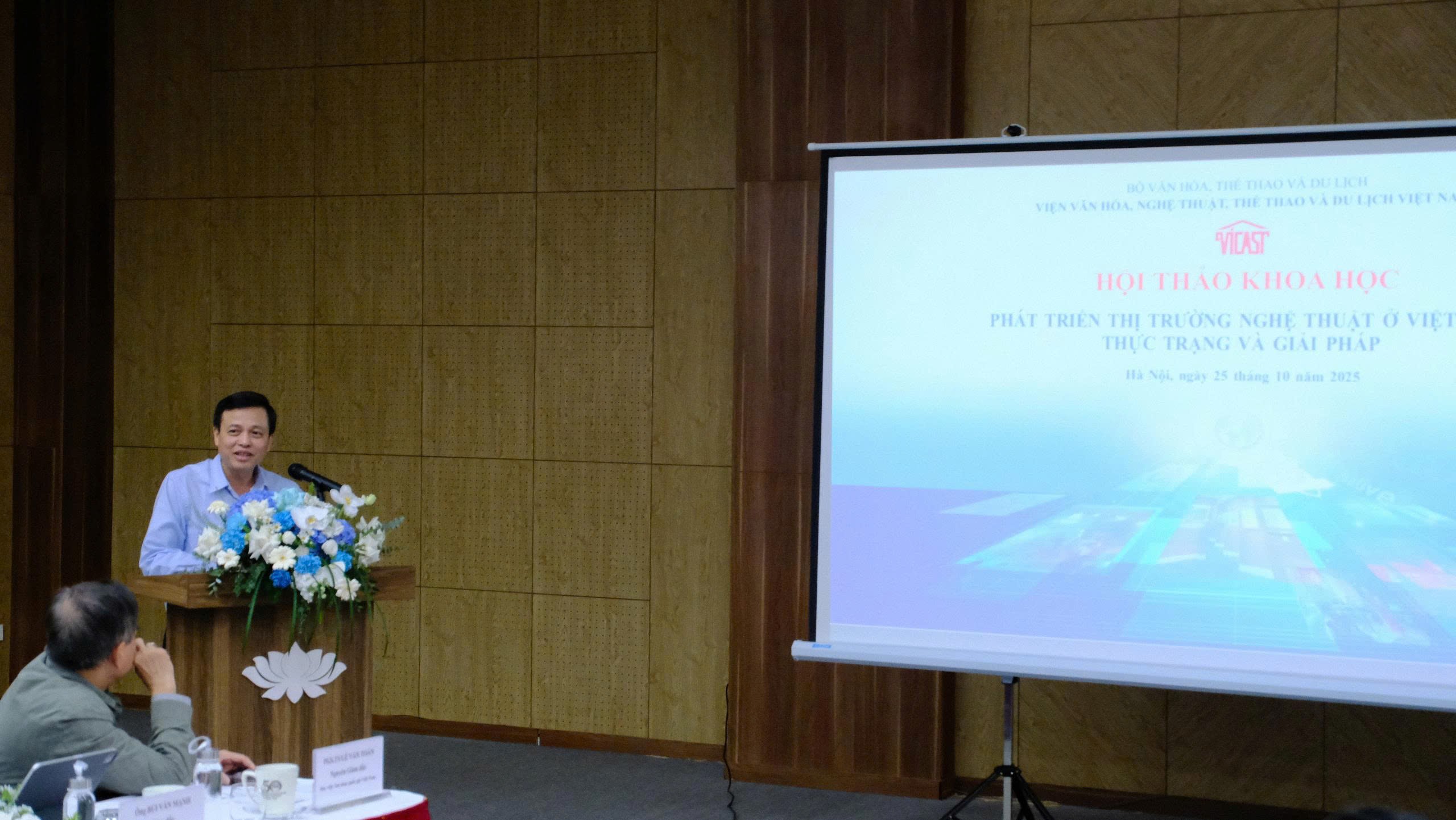
Based on the current situation, Deputy Director General of the Department of Cinema, Mr. Đỗ Quốc Việt, proposed eight specific solutions to foster the sustainable development of Vietnam’s film industry.
First and foremost, he emphasized the importance of raising public awareness to develop the film market. This can be achieved through legal education and civic responsibility campaigns, using easy-to-understand materials, seminars, short courses, or collaboration with media and press agencies.
In addition, digital communication campaigns should be implemented — such as building official management websites to provide information on legal streaming platforms, lists of approved films, and interactive channels connecting businesses and audiences.
Mr. Việt highlighted the need to improve the legal framework and formulate management policies that are aligned with the new realities of the industry.
In particular, the 2022 Law on Cinema requires more detailed guiding documents on online film distribution, OTT content regulation, and copyright infringement handling mechanisms. He also suggested introducing incentive policies for film producers and enterprises, such as tax rebates for productions filmed in Vietnam.
There are incentive policies for businesses and film producers, as well as tax refund policies for film production and filming using locations in Vietnam…
At the same time, he proposed the completion and implementation of the National Film Development Support Fund, to operate as a state financial fund outside the national budget, aimed at promoting the sustainable growth of the film industry.
Another critical solution is to strengthen copyright protection. Technologies such as blockchain and digital watermarking should be utilized to verify ownership and prevent piracy, while strict enforcement must be applied against illegal streaming websites. Parallelly, it is essential to raise public awareness about respecting intellectual property and valuing creative works.
Mr. Việt also underscored the importance of developing film infrastructure and market accessibility. He suggested investment policies to encourage the construction of cinemas and theater complexes in mountainous and rural areas, rather than only in major cities. This would both expand the market and enhance cultural accessibility for the broader population.
Furthermore, investment in modern film studios and the application of advanced technologies — such as virtual reality (VR) and immersive surround sound systems — can help leverage the interdisciplinary nature of the arts while promoting the growth of online film distribution platforms.
He also emphasized the importance of investment policies, social resource mobilization, and film workforce development.
To realize this, Mr. Việt proposed that specialized film training institutions, such as the University of Theatre and Cinema in Hanoi and Ho Chi Minh City, should innovate their training models, update curricula to meet international standards, and modernize teaching and practice facilities.
In addition, international cooperation in education and training, upskilling in new technologies, and the development of professional management personnel for the film industry were cited as practical and essential measures for the future.
In addition, Mr. Đỗ Quốc Việt proposed the development of a comprehensive database system and data analytics framework for the film industry.
To ensure the sustainable growth of Vietnam’s cinema market, Mr. Việt emphasized the need to build a national communication strategy and film branding initiative, while simultaneously enhancing international cooperation.
“Vietnamese cinema needs to be positioned not only as an art form but also as a cultural industry and a creative economy sector — contributing to cultural development, economic growth, and the effective promotion of the national image,” said Deputy Director General of the Department of Cinema, Mr. Đỗ Quốc Việt.
Author: Dung Nguyễn
Source: From “Red Rain” to the Box Office Paradox: What Does Vietnamese Cinema Need for Sustainable Development?